The Allure of Cleopatra
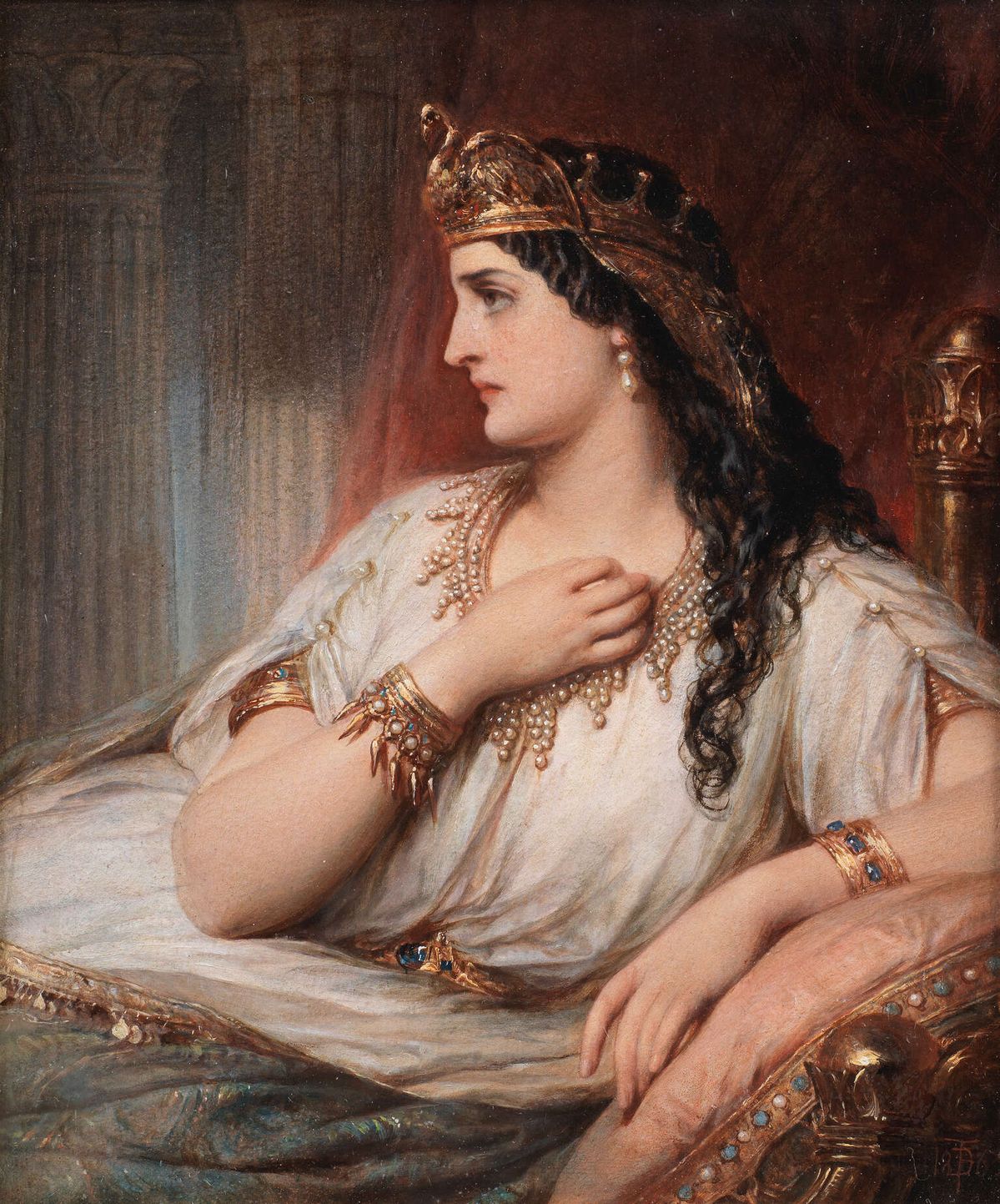
"Age cannot wither her, nor custom stale
Her infinite variety: other women cloy
The appetites they feed: but she makes hungry
Where most she satisfies; for vilest things
Become themselves in her: that the holy priests
Bless her when she is riggish [wanton]."Shakespeare, Antony and Cleopatra (II.ii)
In 1887, The Graphic, an illustrated London weekly, commissioned an exhibit of twenty-one paintings of Shakespeare's heroines. For the Victorians, who idealized the beauty and demure modesty of women, this portrait of Cleopatra by John William Waterhouse, must have been a problematic figure. Here, uncorseted and unashamed, Cleopatra is portrayed as femme fatale, lounging on a leopard skin (in much the same way as she does in Alma-Tadema's Antony and Cleopatra), her sultry gaze defying the viewer, as seductive and potentially poisonous as the asp that bit her—and so the telling quotation from Shakespeare that accompanied the picture when the series was reproduced: "Where's my serpent of old Nile? For so he calls me" (I.v).
Reproductions were sold in portfolio editions the next year and again in 1896, from which this illustration is taken. In 1889, the original paintings were auctioned at Christie's and Cleopatra sold to a London dealer for ninety guineas. It then was lost (Trippi indicated that it was "untraced"), only to be discovered in a cabin in the Rocky Mountains of Colorado. More than a century later, in June 2003, it was to have auctioned by Christie's for an estimated £300,000 to £500,000 but did not meet the reserve.
In the winter of 34 BC, while still married to Octavia, the sister of Octavian (later, Augustus), Antony publicly acknowledged his children by Cleopatra (twins, aged six, and a younger brother), declaring that they would share in the kingdom of Egypt (Dio, Roman History, L.1.5). Later, after the battle of Actium (31 BC), Antony sought to mollify the victorious Octavian by recounting the amorous adventures and youthful pranks they had shared (Dio, LI.8.1). Suetonius, too, quotes from a letter supposedly written by Antony in response to Octavian's criticism (Life of Augustus, LXIX). The Loeb edition translates the passage as:
“What has made such a change in you? Because I lie with the queen? She is my wife. Am I just beginning this, or was it nine years ago? What then of you—do you lie only with Drusilla? Good luck to you if when you read this letter you have not been with Tertullia or Terentilla or Rufilla or Salvia Titisenia, or all of them. Does it matter where or with whom you take your pleasure?”
Robert Graves is less literal in his translation.
"What has come over you? Do you object to my sleeping with Cleopatra? But we are married; and it is not even as though this were anything new—the affair started nine years ago..."
The Latin verb is ineo, which Lewis and Short (1879) translate as "to go into, to enter" or carnally "to know." The Oxford Latin Dictionary offers the same definition but emphasizes its veterinary connotation.
References: Suetonius (1914), Robert Graves (1979), Cleopatra of Egypt: From History to Myth (2001), J.N. Adams (1990), Trippi (2002).